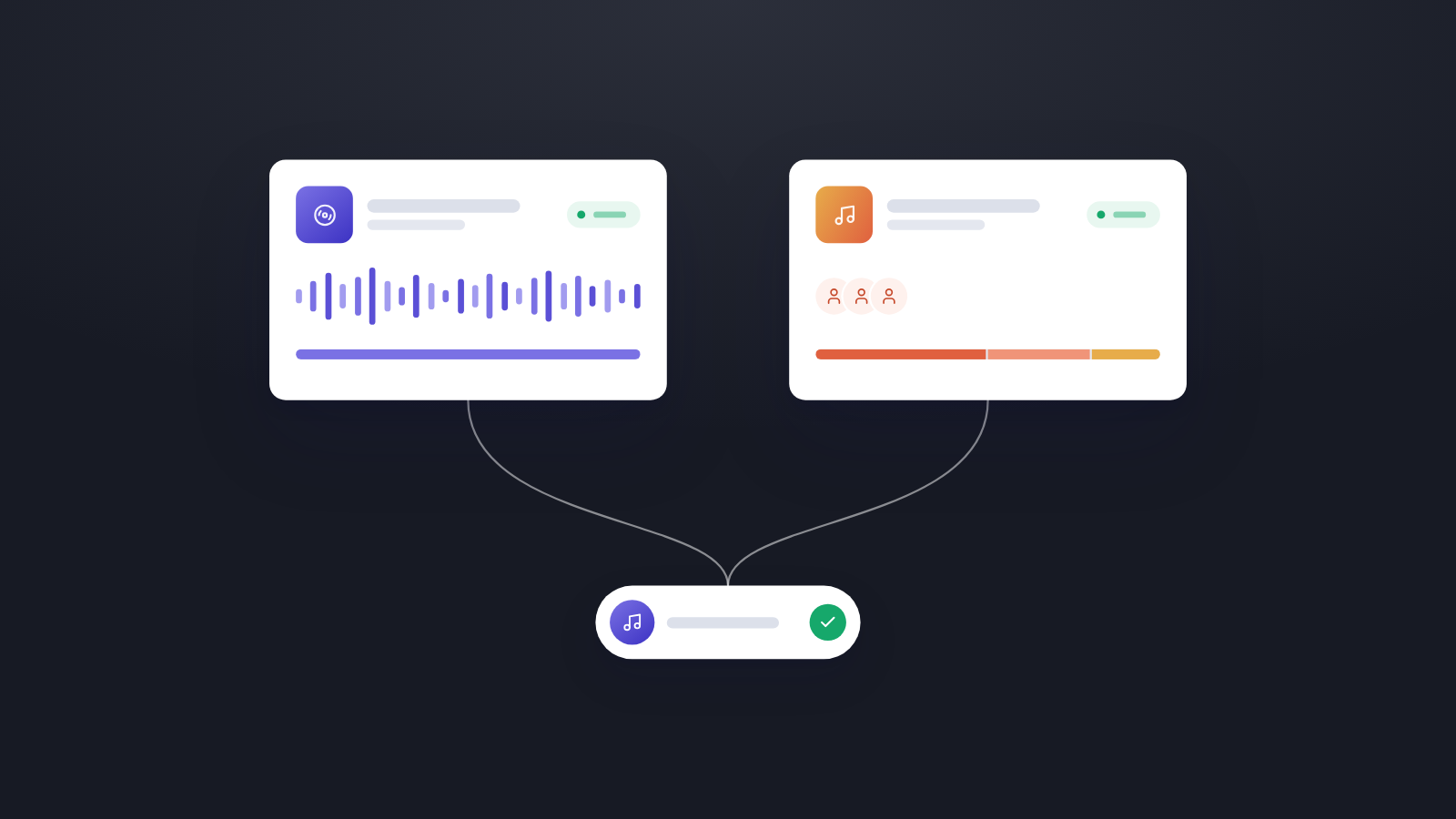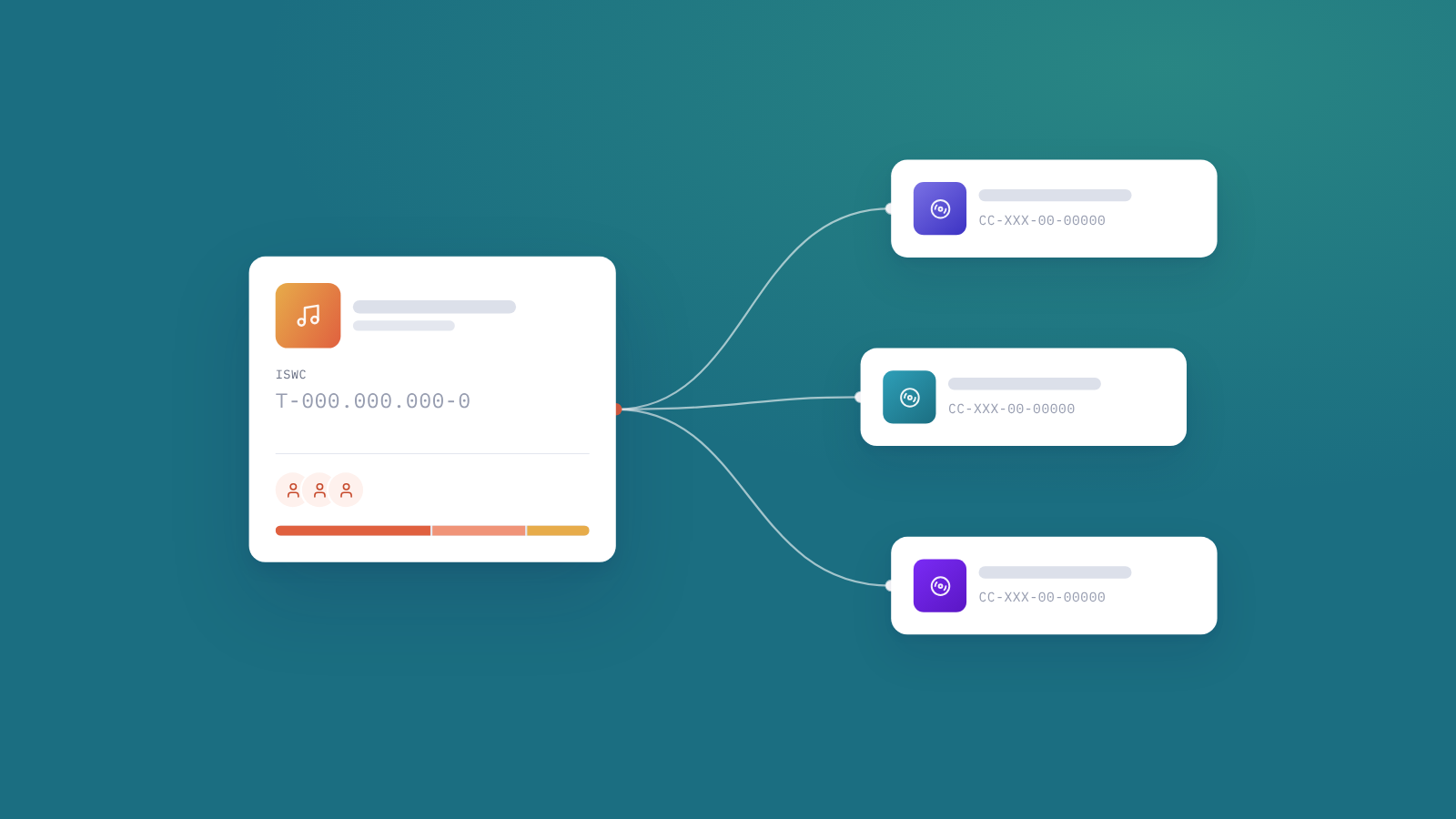
An ISRC identifies a specific recording. An ISWC identifies the song as written. One song can have many ISRCs—the original, a remix, an edit, a live version—while the song itself carries one ISWC, with arrangements and translations getting their own.
Most pages on these codes are written for artists registering their own music. This one is for the other side of the desk: you want to use a song, and the codes help you find out who controls it.
What is an ISRC?
The International Standard Recording Code is the code for a recording. IFPI, which runs the international ISRC system, puts the scope plainly: "ISRC identifies sound recordings and music videos. ISRC is not used to identify compositions/musical works, music products or performers."
An ISRC is 12 characters, shown with the prefix "ISRC" in print. It breaks into three parts:
- a five-character prefix code from the ISRC agency: two letters, then three letters or numbers
- two digits for the year the code was assigned
- a five-digit designation code from the registrant
IFPI's own example is AA-6QZ-20-00047. IFPI's structure page has the full breakdown.
A new or changed recording gets a new code. IFPI says "any new or materially changed recording must be provided with a new ISRC," and names different versions, mixes, and edits as examples. IFPI's guidance on when to assign a code lists the rest.
In the US, the Recording Industry Association of America runs the US ISRC Agency, appointed by the International ISRC Agency. Since July 2020, SoundExchange has been the authoritative source of US ISRC data. To check a code, use the IFPI ISRC Search, which is free.
Why it matters for clearance: the ISRC pins down which master you're licensing. When a song exists as an album cut, a remix, and a live take, the ISRC makes sure you and the rights holder are talking about the same recording.
What is an ISWC?
The International Standard Musical Work Code is the code for the composition. The ISWC agency calls it "a unique, permanent and internationally recognized reference number for the identification of musical works."
An ISWC is the letter T, then nine digits, then a check digit—for example, T-034.524.680-1.
CISAC, the International Confederation of Societies of Authors and Composers, runs the system. Registration agencies assign the codes, and for a new work the code comes with registering it at a society. In the US, the listed agencies are AllTrack, AMRA, ASCAP, BMI, Hexacorp, and SESAC.
Two limits are worth knowing. The ISWC agency says the code "will not identify recordings, sheet music or any other type of performance," and it does "not indicate the shares of composers or copyright owners of the work." Arrangements, lyric adaptations, and translations get their own ISWC.
Why it matters for clearance: the ISWC ties every recording back to one song and its writers. It tells you what you're clearing on the composition side. It doesn't tell you who owns how much.
What's the difference between ISRC and ISWC?
| Code | Identifies | One per | Issued by | Helps you clear |
|---|---|---|---|---|
| ISRC | A recording or music video, not the song | Recording. A new mix, edit, or version gets its own. | The International ISRC Agency (IFPI). In the US, the US ISRC Agency, run by the RIAA. | The master: which recording you're licensing |
| ISWC | A musical work, not its recordings | Work. Arrangements, lyric adaptations, and translations get their own. | CISAC's system, through registration agencies such as ASCAP, BMI, and SESAC | The composition: which song, and its writers. Not the shares. |
| IPI | A party—a writer or a publisher—not a work | Name. A base number groups all of one party's names. | The IPI system, run by SUISA for CISAC, through member societies | Who: which writer or publisher you mean |
What is an IPI number?
An IPI number identifies a person or company, not a song. CISAC describes the system as "the globally unique identification of a natural person or legal entity with an interest in an artistic work." The Swiss society SUISA administers it.
Each name gets an IP Name Number—a civil name, a pseudonym, a spelling variant. An IP Base Number groups all the names of one party. ASCAP's IPI FAQ says the numbers are "usually 9–11 digits long," and that they're assigned to "songwriters, composers and music publishers that own the rights to music."
That's the point of the system for you: it gives every writer and publisher one unique ID. Two publishers with similar names have different numbers, and one writer's pseudonyms all sit under one base number.
The codes also link up. The ISWC agency says an ISWC's record lists all the creators of the work "identified by their IP-numbers and role codes."
Where do PROs fit?
A performing rights organization (PRO) licenses the public performance of songs and pays writers and publishers for those performances. It doesn't grant sync licenses. BMI's licensing FAQ says so directly: it "only licenses performing rights and does not license mechanical or synchronization rights." Sync licenses come from the music publishers.
The four major US PROs are ASCAP, BMI, SESAC, and Global Music Rights (GMR). AllTrack is also a US PRO, accepted by CISAC in August 2024. Abroad, the major societies include PRS for Music in the UK, SOCAN in Canada, GEMA in Germany, and APRA AMCOS in Australia and New Zealand.
So why care about PROs when you're clearing sync? Their public databases are where you find the writers and publishers behind a song.
How do you use these codes to find who to ask?
- Find the ISRC of the recording you want. Check it in the IFPI ISRC Search. This confirms which master you ask for.
- Note the ISWC if you have it. It identifies the composition behind the recording.
- Search the PRO repertory databases for the song. Start with Songview. It shows the writers, the publishers, and the performance shares.
- Note each writer and publisher.
- Look for the Songview checkmark. The checkmark means ASCAP and BMI have the same writers, publishers, and shares for the work.
- For a work from outside the US, search the foreign society that represents it.
- Contact each publisher. Confirm who controls each share before you request a license.
Treat the databases as leads, not proof. ASCAP's terms of use for its repertory search say it "cannot ensure the accuracy, completeness, timeliness, quality or reliability" of its repertory data. BMI's Songview disclaimer says it "cannot give a blanket guarantee regarding the accuracy of the data." And the shares they show are performance shares, which may not match who controls the sync. Confirm that with the publishers.
Songview began in December 2020 as a joint ASCAP and BMI search. In September 2025, the four major US PROs announced that it would add works from SESAC and GMR, starting with works those two represent in full. Ownership percentages for split works were to follow. It doesn't cover foreign societies.
Next: why a song needs a license on both sides, in Master vs composition: the two clearances every song needs.